 Endodontic Rotary Files
 Finishing Burs
 High-Speed Burs
 Low-Speed Drills
 Cosmetic Accessories
 Home Whitening Kits
 Clinic Whitening Kits
 Implant Accessories
 Implant Fixtures
 Prosthetic Components
 Surgical Implant Tools
 CAD & CAM Materials
 Lab Consumables
 Lab Equipment
 Digital Dentistry Devices
 Endodontic Equipment
 General Clinic Equipment
 Restorative Equipment
 Surgical Equipment
 Hand Files
 Irrigation & Medicaments
 Post & Core
 Rotary Files
 Sealers
 Brackets & Wires
 Clear Aligners
 Orthodontic Accessories
 Bonding & Adhesive Systems
 Finishing & Polishing
 Matrix Systems
 Etching Materials
 Composite Materials
 Occlusion Checking
 Bone & Grafting Materials
 Surgical Accessories
 Surgical Consumables
 Cementation
 Impression & Registration Materials
 Temporary Restorations
 Periodontal Instruments & Accessories
 Periodontal Treatment Materials


AI in Dentistry 2026: What African Dental Clinics Should Adopt and What to Avoid

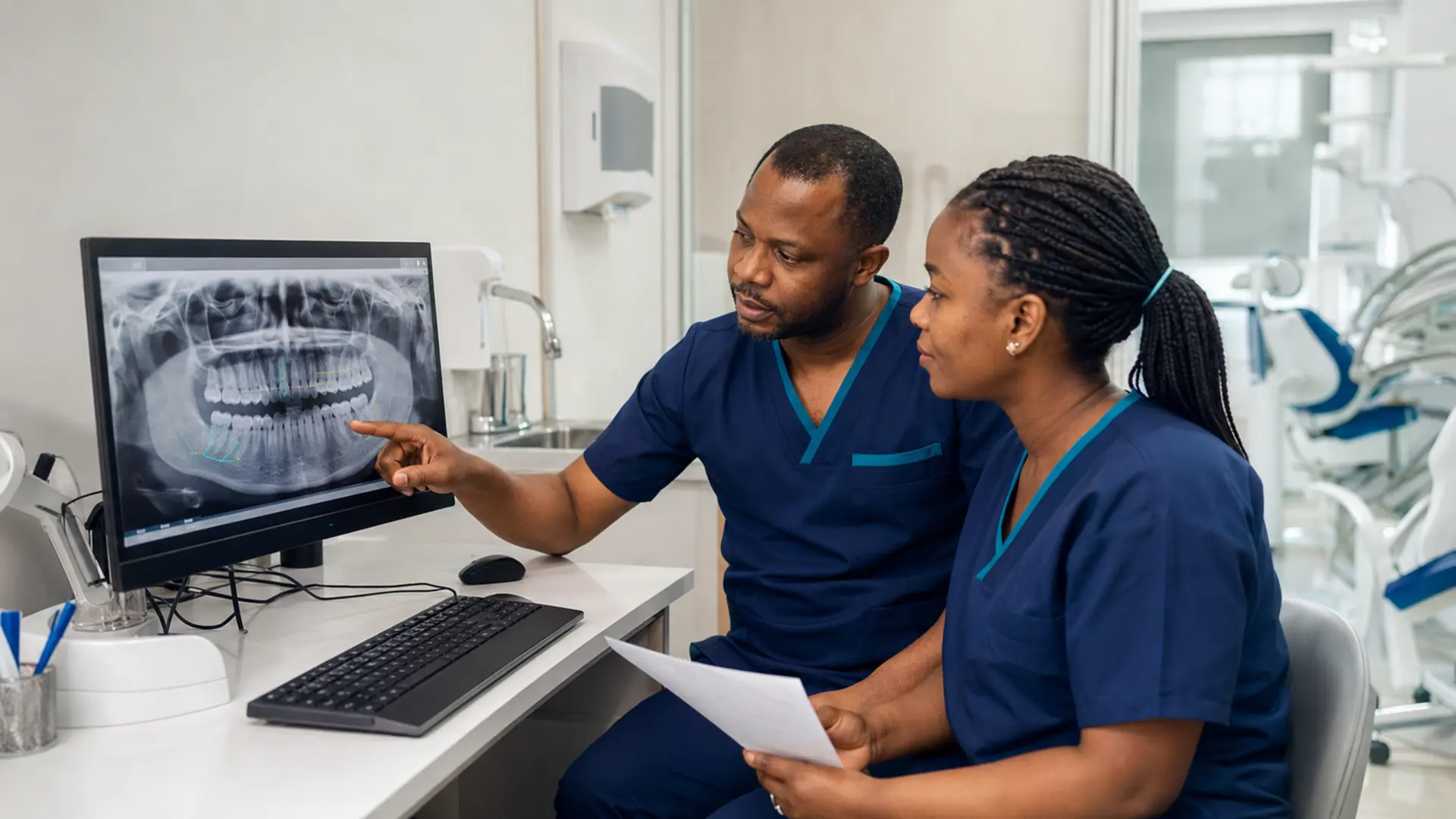
AI In Dentistry 2026 should be evaluated through clinical evidence, workflow fit and local operating conditions. A sound AI in dentistry 2026 decision connects verified performance with the team, patients and resources that will support it in daily practice.
Artificial intelligence has moved quickly from experimental research into everyday software. Dental professionals now encounter AI in radiograph analysis, treatment simulation, administrative automation, documentation and patient communication. The opportunity is real, but so is the risk of adopting systems before their clinical limitations, data requirements and responsibilities are understood.
For African dental clinics, AI may help extend expertise and improve efficiency where specialist access is limited. At the same time, unequal digital infrastructure, under-representation of African populations in training datasets and uncertain data governance make careful evaluation essential.
Quick answer: In 2026, dental AI should be treated as a supervised clinical and operational assistant. It can help identify patterns, organize information and automate repetitive work, but it should not replace examination, diagnosis, informed consent or professional accountability.
Table of Contents
Where AI Is Already Being Used in Dentistry

Radiographic analysis
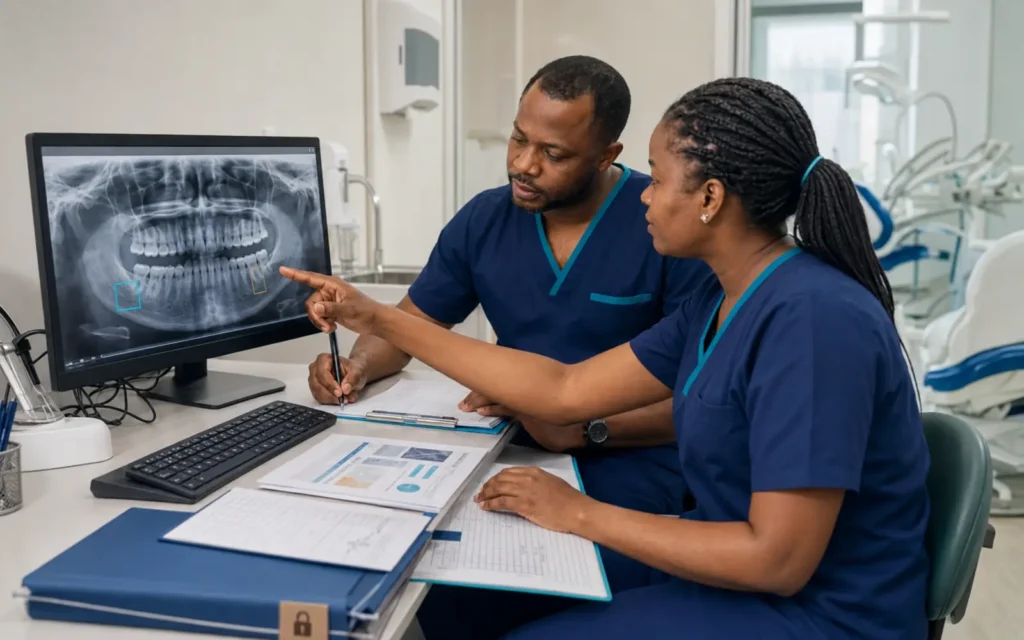
Computer-vision systems can highlight possible caries, periapical changes, bone loss, calculus and anatomical structures. Their value is often greatest as a second set of eyes or a standardized measurement tool. A highlighted area is not a diagnosis; it must be interpreted with symptoms, history, clinical findings and image quality.
Orthodontic and prosthetic planning
AI-assisted software can segment teeth, generate initial setups, identify landmarks and support design workflows. These functions may save time, but automatically generated plans require clinical correction and biological review.
Documentation and administration
Language models can help structure notes, summarize information, draft patient instructions, answer routine questions and prepare internal documents. Administrative use can be a practical first step because it carries less clinical risk than autonomous diagnosis.
Patient communication
AI can translate, simplify or personalize explanations. This is useful in multilingual markets, but generated content must be reviewed for accuracy, cultural appropriateness and compliance with advertising rules.
What the Evidence Actually Shows
Recent reviews describe promising performance across radiology, endodontics, periodontics, orthodontics, implant dentistry and restorative care. However, many studies remain retrospective, use carefully selected datasets or assess technical accuracy rather than real-world patient outcomes.
A model can perform well on a research dataset and still struggle when deployed with different radiographic equipment, image quality, disease prevalence or patient populations. Clinics should therefore ask for external validation, not only internal vendor claims.
What AI Cannot Safely Do
AI should not independently:
- Replace a full dental examination.
- Provide a definitive diagnosis from one image.
- Select treatment without clinician review.
- Determine prognosis without patient context.
- Write final records that the dentist has not checked.
- Communicate risks or consent without professional oversight.
Generative systems can produce fluent statements that are incorrect. This is particularly dangerous when the wording sounds confident. Every clinically relevant output requires verification.
Bias and the African Data Gap
AI performance depends on the data used to develop and test the model. If African populations, local disease patterns, equipment types or imaging conditions are under-represented, the system’s accuracy may not transfer reliably.
Ask vendors:
- Which countries and patient populations were included?
- Which image types and machines were tested?
- Was validation performed outside the developer’s own dataset?
- Are sensitivity and specificity reported by subgroup?
- How are false positives and false negatives handled?
Absence of diverse validation does not automatically make a tool unusable, but it requires more cautious implementation and stronger human review.
Patient Privacy and Data Governance
Before uploading radiographs, scans or clinical notes to an AI service, determine where the data is stored, who can access it and whether it is used to train future models. Patient identifiers should not be entered into public AI tools without an approved legal basis and secure workflow.
A clinic policy should cover:
- Approved AI systems.
- Permitted data types.
- De-identification procedures.
- Consent requirements.
- Retention and deletion.
- Incident reporting.
- Human verification responsibilities.
Infrastructure Questions for African Clinics
Some systems require continuous internet access, cloud processing or high-performance computers. Before adoption, test performance under the clinic’s real bandwidth and power conditions. Confirm what happens during an outage and whether data can be exported if the subscription ends.
For clinics with limited infrastructure, a reliable low-complexity tool may create more value than an advanced platform that depends on constant connectivity.
A Safe Vendor Evaluation Checklist
Request written answers to the following:
- What is the exact intended use?
- Is it a diagnostic aid, measurement tool or administrative system?
- What evidence supports its claims?
- What regulatory status applies in your market?
- How are updates validated?
- Where is data stored and processed?
- Can data be deleted or exported?
- Who provides training and support?
- How are errors reported?
- What happens if the system is unavailable?
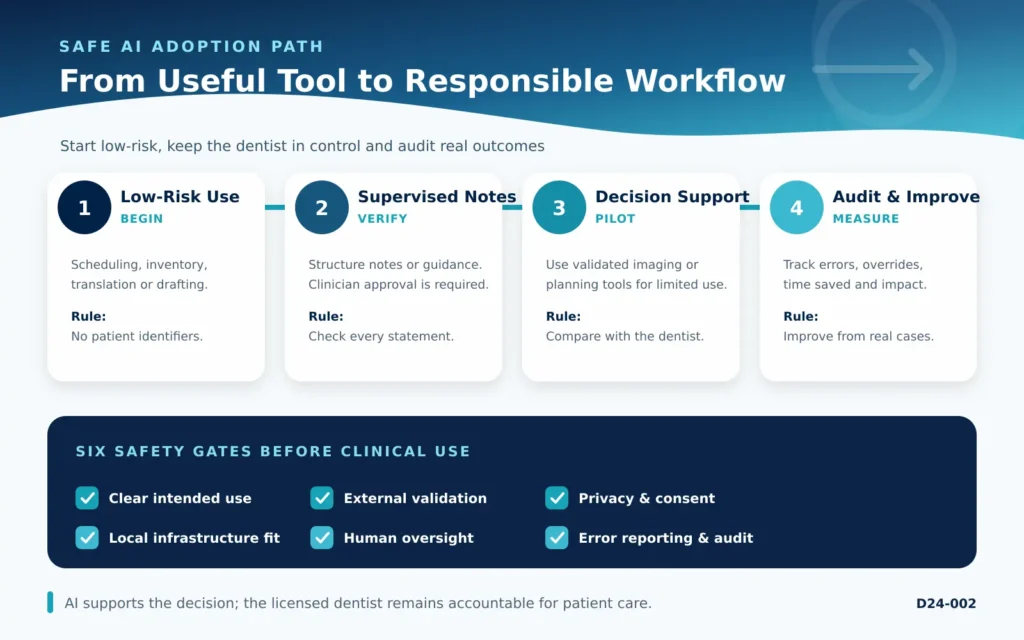
A Practical Adoption Path
Phase 1: Low-risk use. Begin with scheduling, inventory, translation or non-clinical drafting.
Phase 2: Supervised documentation. Use AI to structure notes or patient instructions, with mandatory clinician approval.
Phase 3: Decision support. Introduce validated imaging or planning tools for limited indications and compare them with clinician interpretation.
Phase 4: Audit. Measure errors, time saved, user overrides, patient complaints and workflow impact.
How Denta24 Fits into a Responsible Digital Strategy
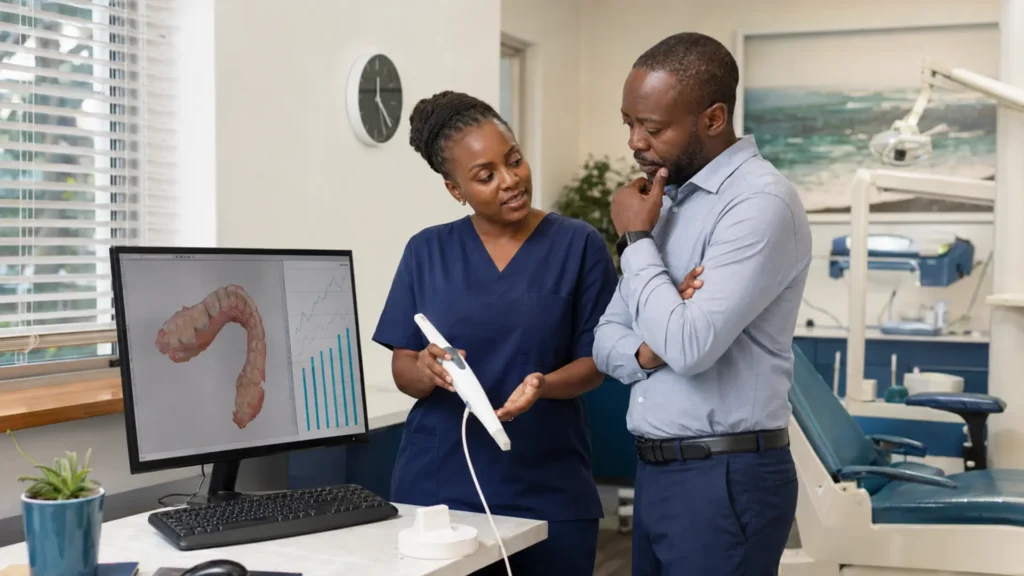
AI does not operate in isolation. It often depends on high-quality digital data from scanners, imaging systems and laboratory workflows. Denta24’s digital dentistry category can support clinics evaluating the equipment foundation required for digital workflows.
The purchase of a scanner or other device should not be described as “AI transformation” unless the clinic also has a clear plan for data quality, training, integration and governance.
AI In Dentistry 2026: Practical Checks for African Clinics
For African clinics, AI in dentistry 2026 is not a product-only decision. It must also account for internet stability, data hosting, patient consent, local regulation, software validation, workflow integration, cybersecurity and clinician oversight. A resilient AI in dentistry 2026 plan should remain workable when supply, connectivity, service access or patient follow-up is less predictable than expected.

Before adoption, document who is responsible, which current instructions for use apply, how outcomes will be measured and what will trigger referral, retraining or a change in protocol. The goal of AI in dentistry 2026 is to separate validated assistance from marketing claims, pilot one low-risk workflow, monitor errors and keep the dentist responsible for every clinical decision.
- Verify internet stability before implementation or purchase.
- Verify data hosting before implementation or purchase.
- Verify patient consent before implementation or purchase.
- Verify local regulation before implementation or purchase.
- Verify software validation before implementation or purchase.
- Verify workflow integration before implementation or purchase.
- Verify cybersecurity and clinician oversight before implementation or purchase.
Use AI in dentistry 2026 as an operational decision that is reviewed after real cases. Record complications, remakes, chair time, consumable use, stock-outs and team feedback, then refine the protocol from evidence rather than marketing claims.
Related Denta24 reading: top digital dentistry equipment trends for 2026. This context helps place AI in dentistry 2026 within a broader clinical and digital strategy.
Conclusion
AI In Dentistry 2026 succeeds when the evidence, local workflow and review plan remain aligned. The most responsible approach to AI in dentistry is neither rejection nor blind adoption. Clinics should begin with specific problems, choose validated tools, protect patient information and maintain clear human oversight. In 2026, the competitive advantage will not come from using the most AI. It will come from using appropriate AI safely and measurably.
Frequently Asked Questions
What is AI currently used for in dentistry?
For context, AI in dentistry 2026 should always be adapted to the individual case and the current evidence. Common uses include image analysis, documentation, scheduling, patient communication, design assistance and clinical decision support.
Can AI diagnose dental disease without a dentist?
No. AI output must be combined with examination, history, clinical judgment and professional responsibility.
Is AI accurate for detecting caries?
Performance can be promising, but it varies by dataset, image quality, lesion definition and clinical environment.
What are the biggest risks of dental AI?
False positives, missed findings, biased training data, privacy problems, poor integration and overreliance are major concerns.
Why does African data representation matter?
Models trained on narrow populations or equipment may perform differently across patient groups, disease patterns and imaging systems.
Does AI require constant internet access?
Some tools are cloud-based and others run locally. The clinic should verify connectivity, downtime and offline limitations.
How should a clinic evaluate an AI vendor?
Request intended use, external validation, regulatory information, data location, security controls, update policy and support arrangements.
Can generative AI write clinical notes?
It can assist drafting, but the clinician must verify accuracy and must not expose patient-identifiable information to an unapproved system.
Who is responsible when AI makes an error?
Professional and organizational responsibility generally remains with the clinicians and clinic using the system.
What is a safe first AI project?
A low-risk administrative workflow, such as document preparation or inventory support, is often a safer place to begin.
References and Further Reading
- Artificial Intelligence in Dentistry: Narrative Review
- Concerns regarding deployment of AI-based applications in dentistry
- Denta24 digital dentistry devices
Professional disclaimer: AI tools should support—not replace—licensed clinical judgment. Verify local legal, privacy and regulatory requirements before introducing any system.