 Endodontic Rotary Files
 Finishing Burs
 High-Speed Burs
 Low-Speed Drills
 Cosmetic Accessories
 Home Whitening Kits
 Clinic Whitening Kits
 Implant Accessories
 Implant Fixtures
 Prosthetic Components
 Surgical Implant Tools
 CAD & CAM Materials
 Lab Consumables
 Lab Equipment
 Digital Dentistry Devices
 Endodontic Equipment
 General Clinic Equipment
 Restorative Equipment
 Surgical Equipment
 Hand Files
 Irrigation & Medicaments
 Post & Core
 Rotary Files
 Sealers
 Brackets & Wires
 Clear Aligners
 Orthodontic Accessories
 Bonding & Adhesive Systems
 Finishing & Polishing
 Matrix Systems
 Etching Materials
 Composite Materials
 Occlusion Checking
 Bone & Grafting Materials
 Surgical Accessories
 Surgical Consumables
 Cementation
 Impression & Registration Materials
 Temporary Restorations
 Periodontal Instruments & Accessories
 Periodontal Treatment Materials


Digital Impressions vs Conventional Impressions: Accuracy, Cost and Workflow

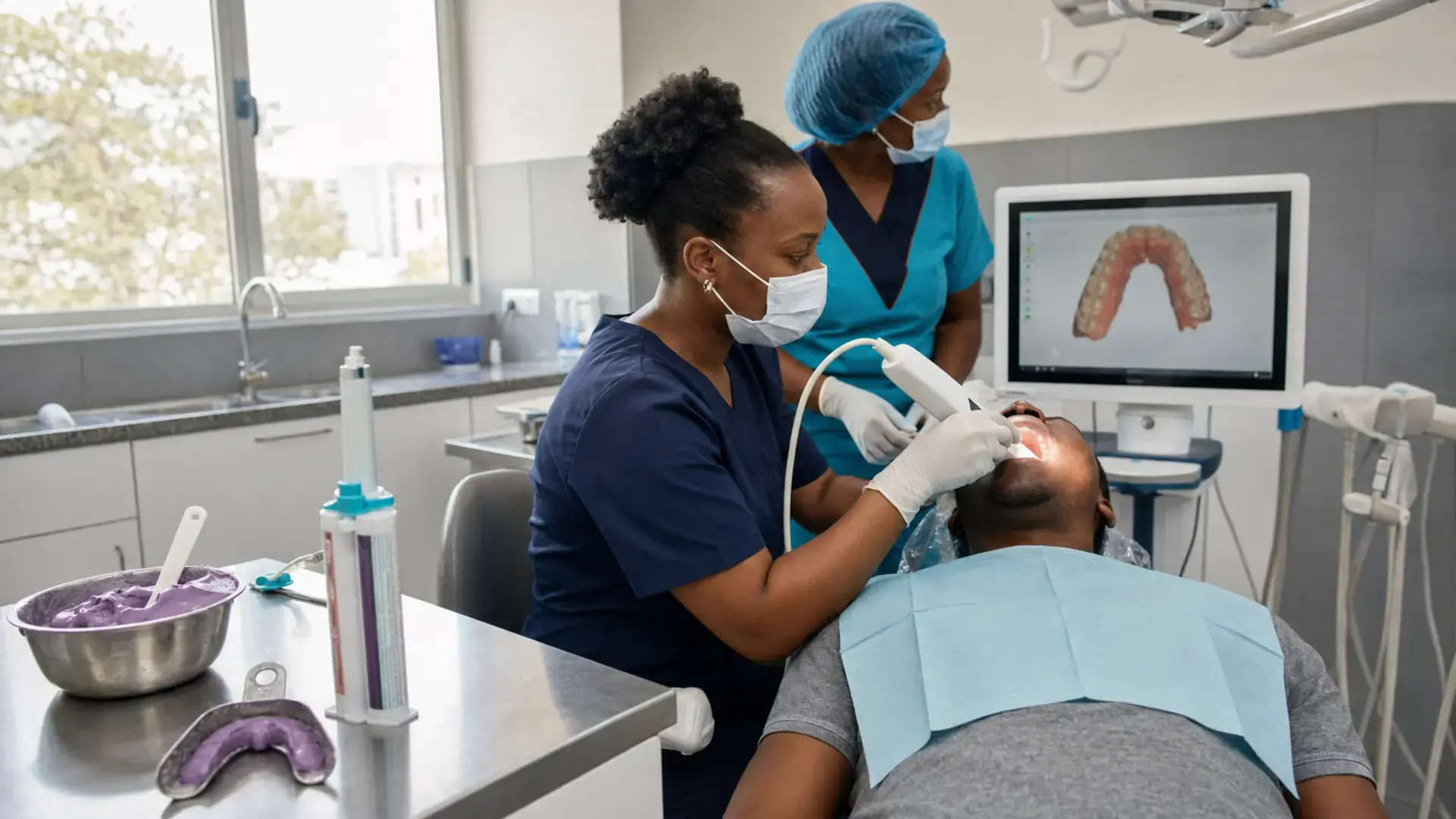
Digital Impressions Vs Conventional Impressions should be evaluated through clinical evidence, workflow fit and local operating conditions. A sound digital impressions vs conventional impressions decision connects verified performance with the team, patients and resources that will support it in daily practice.
Digital impressions are now routine in many restorative, orthodontic and implant workflows, yet conventional impressions remain clinically relevant. The decision is not a competition between old and new technology. It is a question of which method produces a dependable record for the specific patient, restoration and operating environment.
For African clinics, digital files may reduce transport delays and simplify collaboration with distant laboratories. At the same time, equipment cost, training, technical support and difficult full-arch indications must be considered honestly.
Quick answer: Digital impressions are highly effective for many single crowns, short-span restorations, aligner records and selected implant cases. Conventional impressions remain valuable when soft-tissue control, edentulous anatomy, deep margins or extensive full-arch accuracy make digital capture less predictable.
Table of Contents
How the Two Workflows Differ
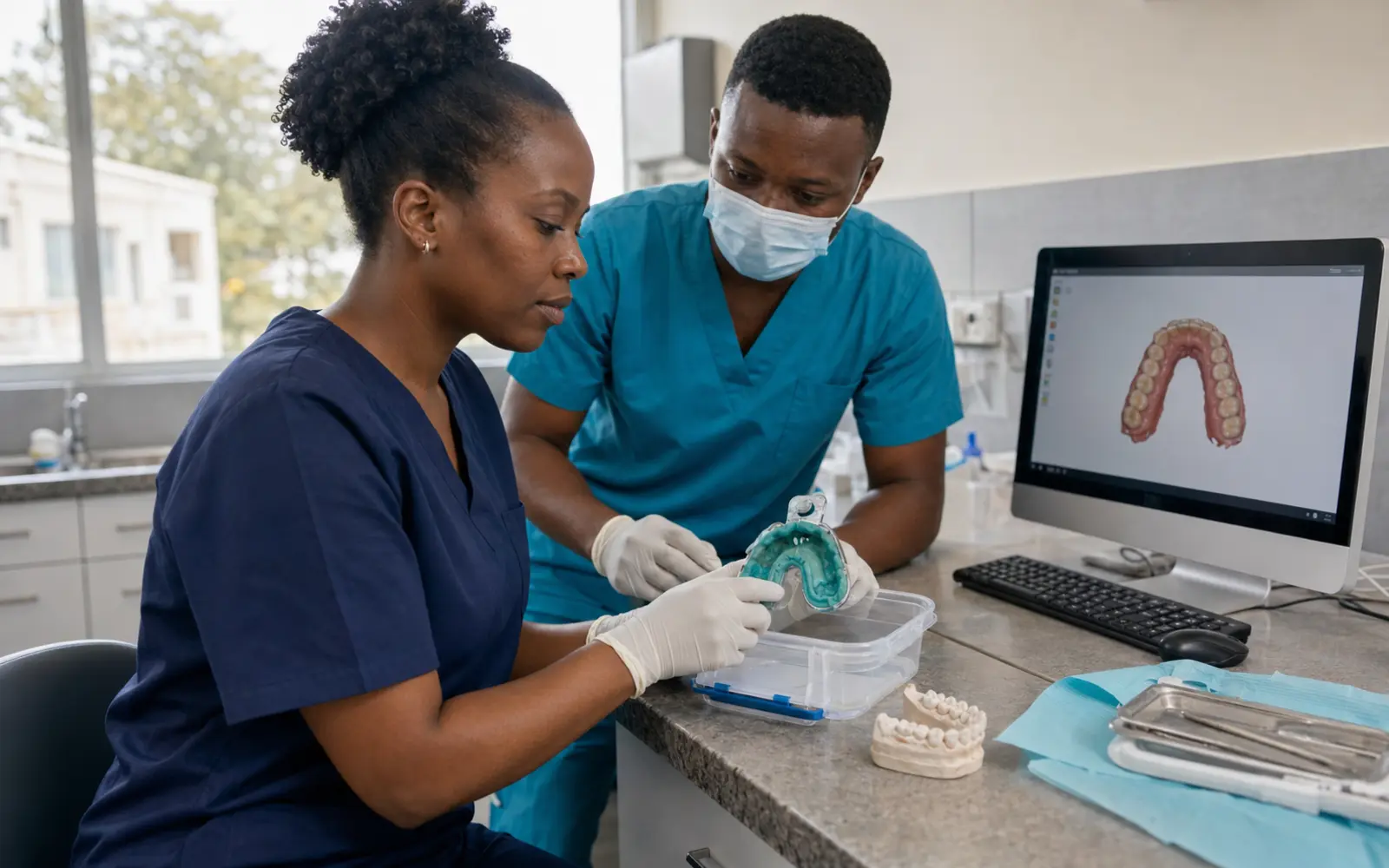
A conventional impression records oral structures in an elastomeric or other material inside a tray. The impression is disinfected and sent to a laboratory, where a cast or digital model is produced.
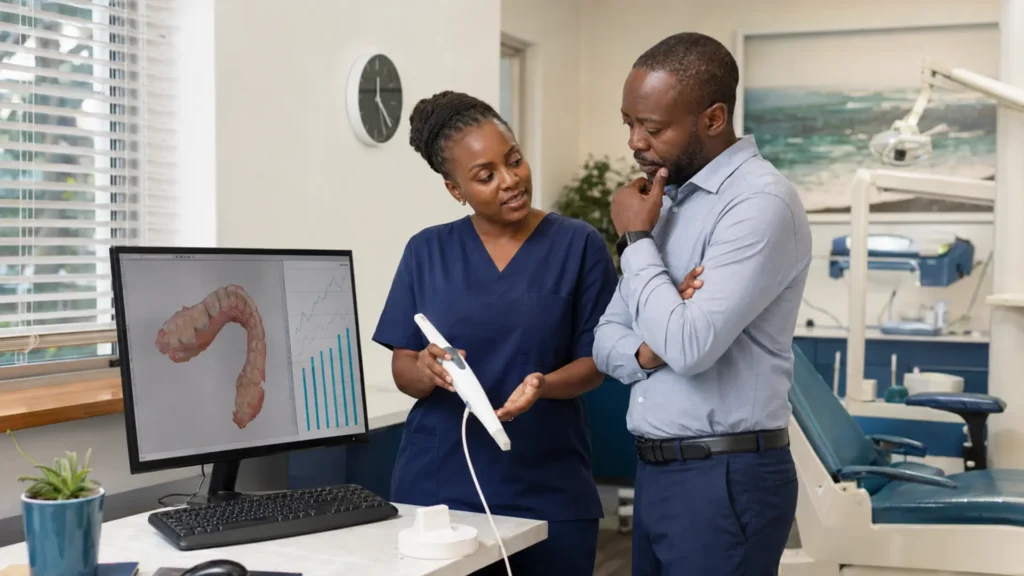
An intraoral scanner captures a sequence of optical images and combines them into a three-dimensional surface model. The operator can inspect the scan immediately and send the file electronically.
Understanding Accuracy: Trueness and Precision
Trueness describes how closely the result matches the actual anatomy. Precision describes how consistently the method reproduces the same result.
Both digital and conventional impressions can be accurate, but their errors occur differently. Conventional materials may distort during seating, removal, disinfection, transport or model pouring. Digital scans may develop stitching errors, missing surfaces or distortion over long scan paths.
Single Crowns and Short-Span Restorations
For many single crowns, inlays, onlays and short bridges, digital impressions provide a predictable and efficient workflow. The dentist can enlarge the view, inspect margins and rescan a small area without repeating the entire procedure.
The main requirements remain unchanged: clear margins, adequate tissue displacement, hemostasis, moisture control and a preparation that the scanner can see.
Full-Arch and Multi-Implant Cases
Accuracy can become more challenging as the scanned span increases. Edentulous areas provide fewer distinctive landmarks, and multiple implant scan bodies require precise capture of position and orientation.
Recent reviews suggest that digital methods can perform well, but results vary with the number and distribution of implants, scanner, scan strategy and verification method. Complex full-arch implant cases should be completed only with a validated protocol and appropriate verification.
Patient Experience
Many patients prefer digital scanning because it avoids impression trays, material taste and gagging. Scanning also allows breaks and targeted rescanning. However, a bulky scanner tip, restricted opening, excessive saliva or severe anxiety can still make the procedure difficult.
Conventional impressions may be faster in the hands of an experienced clinician for certain indications. Patient preference should be considered, but it should not override accuracy.
Chair Time and Team Efficiency
Digital scanning can reduce mixing, tray selection, disinfection and courier preparation. The time advantage improves as the team becomes experienced. Early in adoption, scanning may take longer because the operator is learning tissue management and scan strategy.
Measure total workflow time rather than only active scan time. Include preparation, rescanning, file review, laboratory upload and any repeated appointment.
Cost Comparison
Conventional impressions require recurring materials, trays, adhesives, disinfection, models and shipping. Digital workflows require capital equipment, computer hardware, software and support.
A mixed clinic should calculate cost per completed case for both methods. This prevents an expensive scanner from being justified only by general claims about modernization.
Laboratory Communication
Digital files can shorten communication cycles. A laboratory can identify an unclear margin or missing area while the patient is still in the clinic. Photographs, shade information and design instructions can be attached to the case.
Before changing workflow, confirm:
- Accepted file formats.
- Portal or software access.
- Implant library compatibility.
- Data-retention policy.
- Turnaround and technical support.
When Conventional Impressions Remain Useful
- Deep subgingival margins that cannot be visually exposed.
- Some edentulous and functional-border procedures.
- Cases with uncontrolled bleeding or moisture.
- Workflows where the laboratory cannot receive compatible files.
- Situations where scanner hardware or support is unavailable.
A Hybrid Workflow for African Clinics
A phased approach is often safest. Begin with diagnostic scans, aligner records and straightforward fixed restorations. Keep conventional materials available for difficult indications. Review which cases are accepted or rejected by the laboratory and gradually expand the digital protocol.
This reduces operational risk and prevents the team from feeling forced to use the scanner where it is not clinically appropriate.
The Aidite Rapid 5 as a Digital Option
Denta24 lists the Aidite Rapid 5 Intraoral Scanner within its digital dentistry category. Before purchase, verify current specifications, export options, software terms and support. The scanner should be evaluated against the clinic’s real indications and laboratory network.
Clinical Decision Table
- Single crown: digital is often efficient when margins are visible.
- Short bridge: digital is commonly suitable with correct tissue control.
- Aligner records: digital offers strong workflow advantages.
- Single implant: digital can be predictable with the correct scan body.
- Complete-arch implants: use a validated advanced protocol and verification.
- Edentulous functional impression: conventional or hybrid methods may remain appropriate.
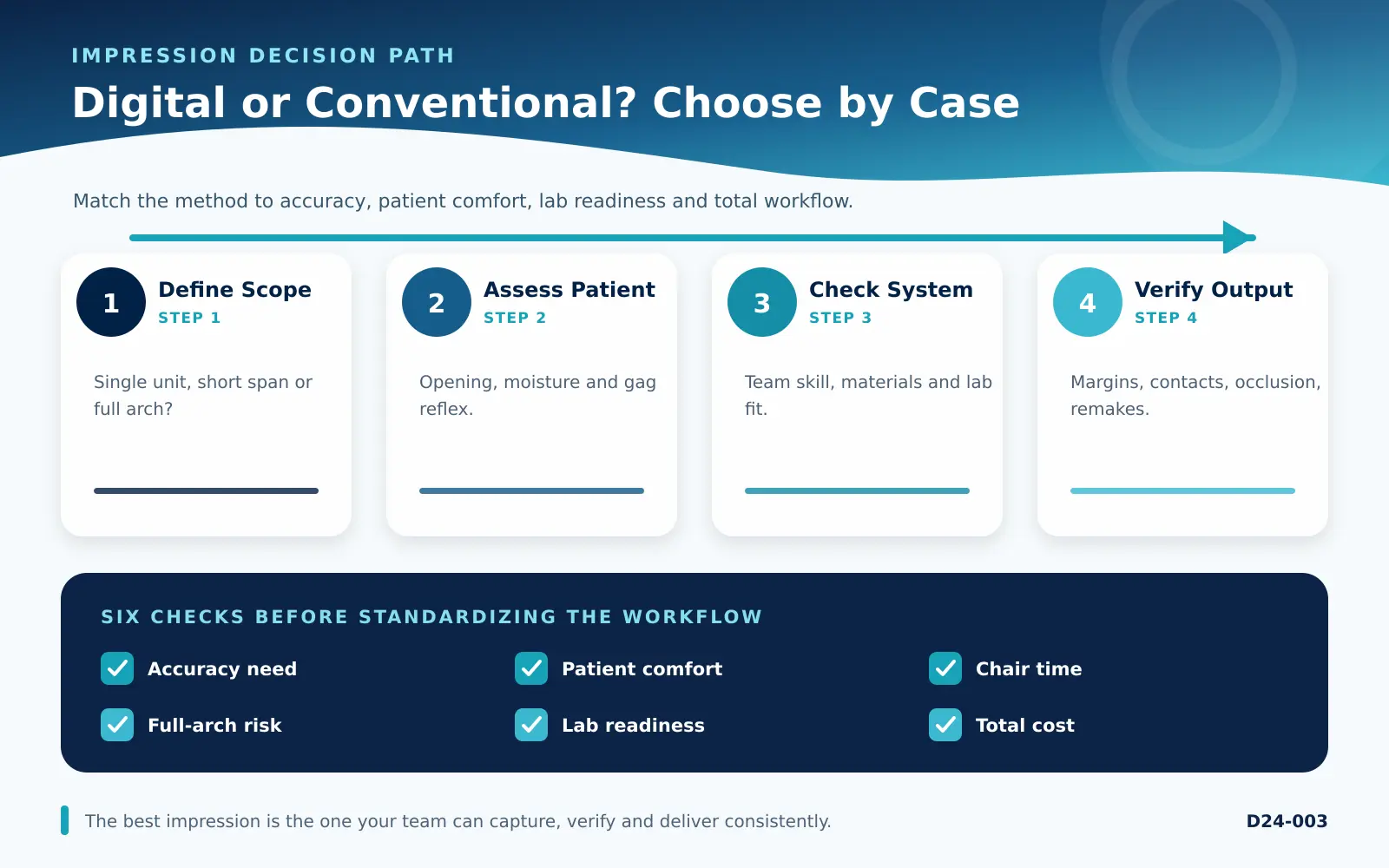
Digital Impressions Vs Conventional Impressions: Practical Checks for African Clinics
For African clinics, digital impressions vs conventional impressions is not a product-only decision. It must also account for laboratory access, shipping time, scanner utilization, impression material supply, moisture control, full-arch case selection and technical support. A resilient digital impressions vs conventional impressions plan should remain workable when supply, connectivity, service access or patient follow-up is less predictable than expected.
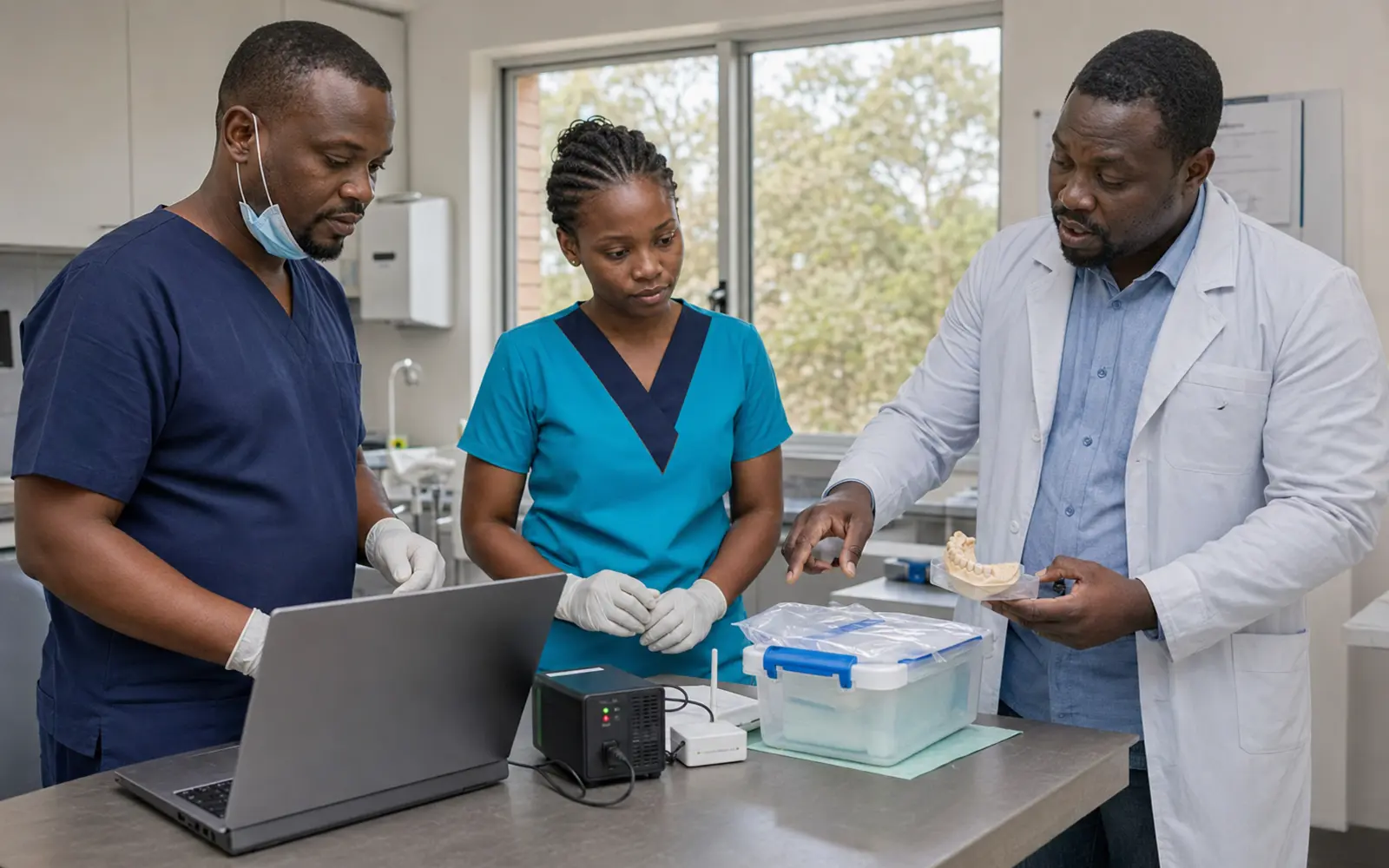
Before adoption, document who is responsible, which current instructions for use apply, how outcomes will be measured and what will trigger referral, retraining or a change in protocol. The goal of digital impressions vs conventional impressions is to choose the method case by case instead of replacing every conventional workflow, and track remakes, chair time, transport cost and laboratory acceptance.
- Verify laboratory access before implementation or purchase.
- Verify shipping time before implementation or purchase.
- Verify scanner utilization before implementation or purchase.
- Verify impression material supply before implementation or purchase.
- Verify moisture control before implementation or purchase.
- Verify full-arch case selection and technical support before implementation or purchase.
Use digital impressions vs conventional impressions as an operational decision that is reviewed after real cases. Record complications, remakes, chair time, consumable use, stock-outs and team feedback, then refine the protocol from evidence rather than marketing claims.
Related Denta24 reading: digital dentistry technology trends. This context helps place digital impressions vs conventional impressions within a broader clinical and digital strategy.
Conclusion
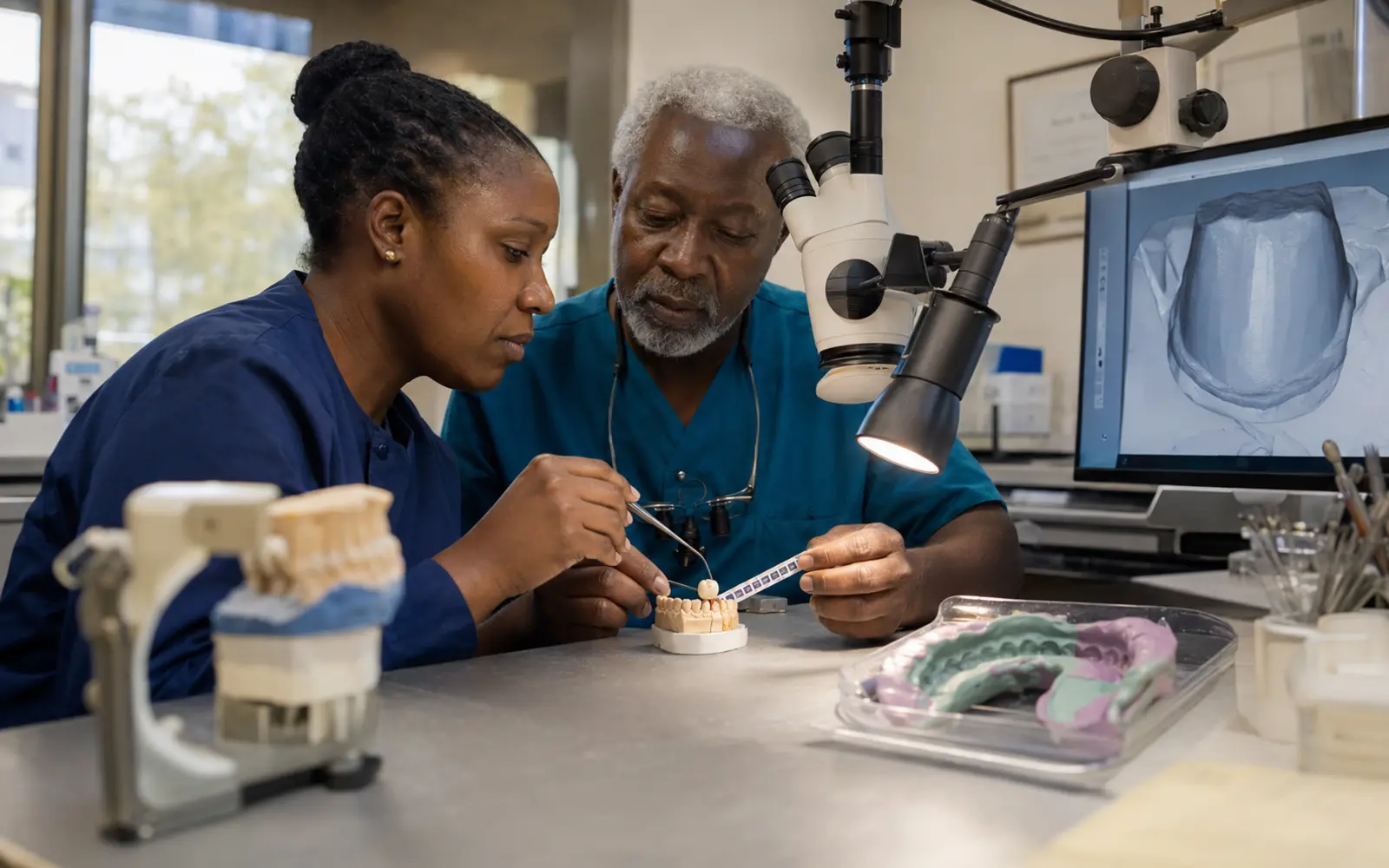
Digital Impressions Vs Conventional Impressions succeeds when the evidence, local workflow and review plan remain aligned. Digital and conventional impressions are both tools. The best clinic uses each where it produces the most reliable result. Digital workflows offer speed, communication and patient-experience advantages, while conventional methods remain important for selected complex indications and as a dependable backup.
Frequently Asked Questions
Are digital impressions more accurate than conventional impressions?
For context, digital impressions vs conventional impressions should always be adapted to the individual case and the current evidence. They are highly reliable for many clinical situations, especially single units and short spans. Full-arch accuracy is more variable.
Which method is more comfortable for patients?
Many patients prefer scanning because it avoids trays and impression material, although restricted access can still be challenging.
Do digital impressions reduce remakes?
They can reduce errors through immediate inspection, but poor tissue control and scan technique can still cause remakes.
Are conventional impressions still necessary?
Yes. They remain useful in selected edentulous, deep-margin, full-arch and moisture-challenged cases.
Which method is cheaper?
Conventional methods have recurring material and transport costs; digital systems have higher initial and technology-support costs.
Can digital files be sent to any laboratory?
Only if the laboratory accepts the scanner’s file format or has access to its platform.
What affects scan accuracy?
Scan strategy, span, saliva, blood, soft tissue, reflective surfaces, preparation design and operator experience all matter.
How should subgingival margins be captured?
Use effective retraction, hemostasis, moisture control and immediate scanning while the margin remains visible.
Are full-arch implant scans predictable?
They can be, but they are advanced and require validated protocols, correct scan bodies and verification.
Should a clinic use a hybrid workflow?
Yes, particularly during adoption. It allows the team to select the most reliable method for each indication.
References and Further Reading
- Comparative analysis of digital and conventional implant impressions
- Accuracy of full-arch intraoral scans
- Aidite Rapid 5 on Denta24
Professional disclaimer: Select impression techniques according to the clinical indication, professional competence and the current instructions of the materials and devices used.