
 Endodontic Rotary Files
 Finishing Burs
 High-Speed Burs
 Low-Speed Drills
 Cosmetic Accessories
 Home Whitening Kits
 Clinic Whitening Kits
 Implant Accessories
 Implant Fixtures
 Prosthetic Components
 Surgical Implant Tools
 CAD & CAM Materials
 Lab Consumables
 Lab Equipment
 Digital Dentistry Devices
 Endodontic Equipment
 General Clinic Equipment
 Restorative Equipment
 Surgical Equipment
 Hand Files
 Irrigation & Medicaments
 Post & Core
 Rotary Files
 Sealers
 Brackets & Wires
 Clear Aligners
 Orthodontic Accessories
 Bonding & Adhesive Systems
 Finishing & Polishing
 Matrix Systems
 Etching Materials
 Composite Materials
 Occlusion Checking
 Bone & Grafting Materials
 Surgical Accessories
 Surgical Consumables
 Cementation
 Impression & Registration Materials
 Temporary Restorations
 Periodontal Instruments & Accessories
 Periodontal Treatment Materials


Rotary vs Reciprocating Endodontics: Choosing a Safer Canal Preparation System


Rotary Vs Reciprocating Endodontics should be evaluated through clinical evidence, workflow fit and local operating conditions. A sound rotary vs reciprocating endodontics decision connects verified performance with the team, patients and resources that will support it in daily practice.
Nickel-titanium instrumentation has improved root canal preparation, but no motion or file system eliminates procedural risk. Rotary and reciprocating systems differ in movement and sequence, yet both require glide-path control, irrigation, anatomy awareness and correct motor settings.
Quick answer: Choose rotary or reciprocating instrumentation according to canal anatomy, operator training, the complete file protocol and motor compatibility. The safest system is the one used exactly as designed within a controlled endodontic workflow.
Table of Contents
How Rotary Motion Works
Rotary files rotate continuously in one direction. Systems may use a sequence of instruments with different tapers and tip sizes. Speed and torque are specified by the manufacturer.
Advantages can include efficient shaping and a progressive sequence. Risks include torsional stress when the tip binds and cyclic fatigue in curved canals.

How Reciprocating Motion Works
Reciprocating systems alternate clockwise and counterclockwise movement, often using one primary shaping file. The exact angles and motor program are system-specific.
Reciprocation may simplify the sequence, but it does not remove the need for coronal access, glide path, irrigation and controlled advancement.
Cyclic Fatigue and Torsional Failure
Cyclic fatigue occurs when the file repeatedly flexes in a curved canal.
Torsional failure occurs when part of the file locks while the motor continues to apply force.
Alloy treatment, design, canal curvature, reuse, speed and technique affect resistance. Inspect files and follow single-use or reuse limits.
Canal Anatomy Comes First
Evaluate radiographs and, where indicated, three-dimensional imaging. Consider:
- Curvature and radius.
- Calcification.
- Canal diameter.
- Previous treatment.
- Root thickness.
- Apical anatomy.
Difficult anatomy should be referred when it exceeds the clinician’s training or equipment.
Access and Glide Path
A straight-line or appropriately conservative access reduces instrument stress. A reproducible glide path allows shaping files to follow the canal rather than create a path forcibly.
Use small hand files or a validated mechanical glide-path system according to the file manufacturer’s recommendations.
Motor Settings
Never guess speed, torque or reciprocation program. Use a motor that supports the exact system and select the validated setting. Using a rotary file in a reciprocating mode—or the reverse—without manufacturer approval can create serious risk.
Instrumentation Technique
- Use light apical pressure.
- Advance in short controlled movements.
- Clean flutes frequently.
- Recapitulate when indicated.
- Irrigate continuously.
- Do not force a file that stops progressing.
- Replace distorted or damaged instruments.
Irrigation Is Not Optional
Files shape the main canal but cannot clean all fins, isthmuses and lateral anatomy. Chemical irrigation is essential for microbial control and tissue dissolution.
Use irrigants, concentrations and activation methods according to safe endodontic protocols. Prevent extrusion beyond the apex.
Single Use and Reuse
Reuse can increase fatigue and complicate traceability. Some systems are designed for single use. Follow the manufacturer’s instructions, local infection-control rules and the clinic’s documented policy.
Rotary vs Reciprocating: A Practical Selection
Rotary may suit clinicians comfortable with a sequential shaping strategy and cases requiring controlled enlargement.
Reciprocating may suit clinics seeking a simplified sequence, provided the operator understands the system’s limitations and motor requirements.
Neither should be selected only because it uses fewer files.
Denta24 Endodontic Categories
Denta24 organizes Endodontic Materials, including rotary files, hand files, irrigation materials and equipment. Build the system as a complete protocol rather than purchasing isolated files without the correct motor and training.
African Clinic Considerations
Verify continuous supply of the selected file sizes, replacement motor support and training. Switching systems frequently because stock is unavailable increases protocol inconsistency.
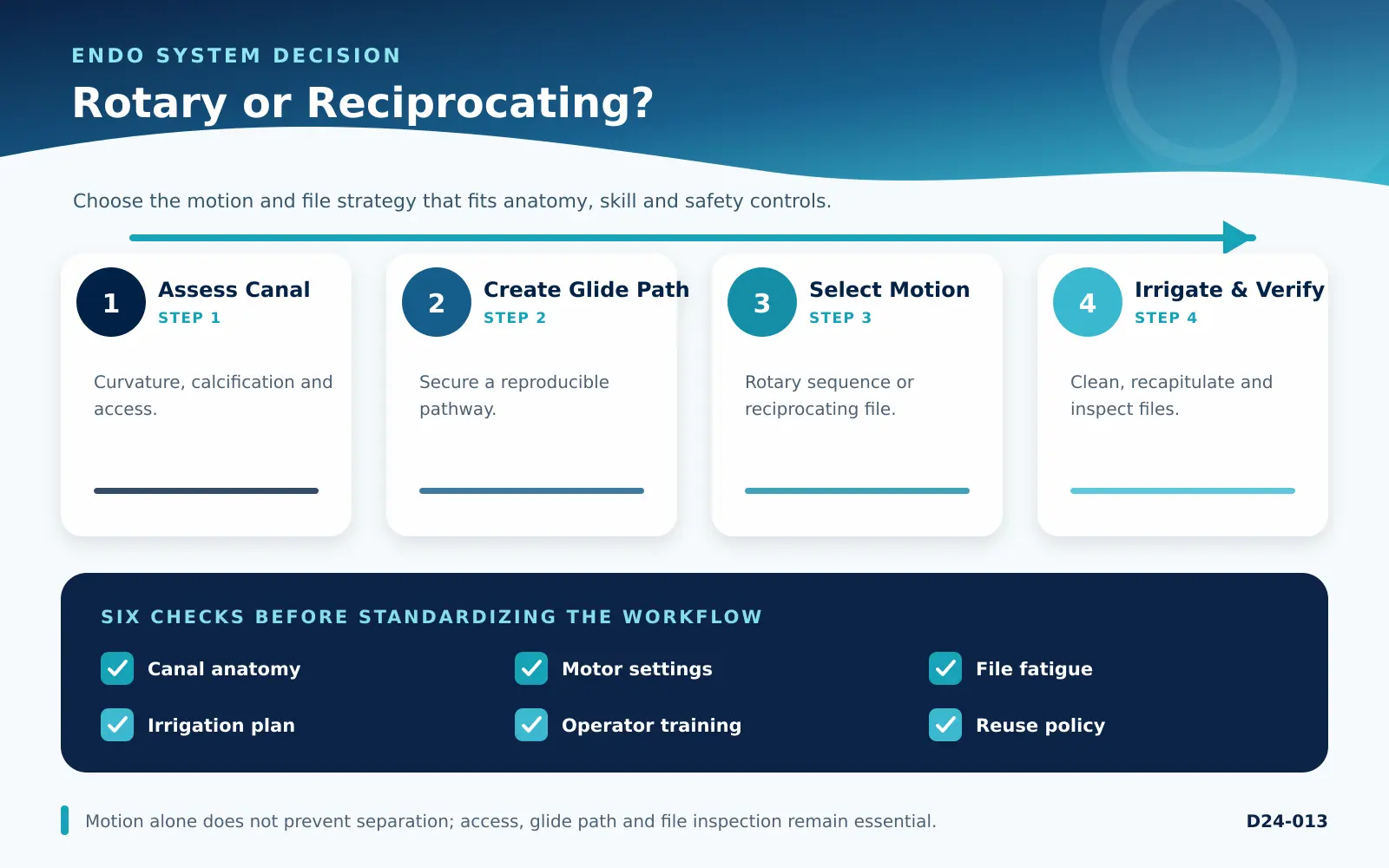
Rotary Vs Reciprocating Endodontics: Practical Checks for African Clinics
For African clinics, rotary vs reciprocating endodontics is not a product-only decision. It must also account for motor compatibility, file supply, training, sterilization and reuse policy, canal complexity, magnification, irrigation resources and referral access. A resilient rotary vs reciprocating endodontics plan should remain workable when supply, connectivity, service access or patient follow-up is less predictable than expected.

Before adoption, document who is responsible, which current instructions for use apply, how outcomes will be measured and what will trigger referral, retraining or a change in protocol. The goal of rotary vs reciprocating endodontics is to select the motion and file system around anatomy and a reproducible glide path, then follow current manufacturer settings instead of mixing protocols.
- Verify motor compatibility before implementation or purchase.
- Verify file supply before implementation or purchase.
- Verify training before implementation or purchase.
- Verify sterilization and reuse policy before implementation or purchase.
- Verify canal complexity before implementation or purchase.
- Verify magnification before implementation or purchase.
- Verify irrigation resources and referral access before implementation or purchase.
Use rotary vs reciprocating endodontics as an operational decision that is reviewed after real cases. Record complications, remakes, chair time, consumable use, stock-outs and team feedback, then refine the protocol from evidence rather than marketing claims.
Related Denta24 reading: dental material quality guide. This context helps place rotary vs reciprocating endodontics within a broader clinical and digital strategy.

Conclusion
Rotary Vs Reciprocating Endodontics succeeds when the evidence, local workflow and review plan remain aligned. Rotary and reciprocating files can both produce effective shaping. Safety depends on anatomy, glide path, irrigation, motor programming and operator discipline. The file is only one component of successful root canal treatment.
Frequently Asked Questions
What is rotary instrumentation?
For context, rotary vs reciprocating endodontics should always be adapted to the individual case and the current evidence. A motor continuously rotates nickel-titanium files according to a defined sequence and setting.
What is reciprocating instrumentation?
The file alternates rotational directions using a system-specific motor program.
Which has lower fracture risk?
Risk depends on alloy, design, anatomy, motion, torque, reuse and technique. No system is risk-free.
What is cyclic fatigue?
It is fatigue caused by repeated tension and compression as a file flexes in a curved canal.
What is torsional failure?
It occurs when the file binds while the motor continues to apply force.
Is a glide path necessary?
A reproducible glide path is important for many systems and canal anatomies.
Can files be reused?
Follow the specific manufacturer and infection-control policy. Many systems are intended for single use.
How should motor settings be chosen?
Use only the speed, torque and motion validated for the specific file.
Does instrumentation replace irrigation?
No. Chemical cleaning remains essential because files cannot contact all canal anatomy.
Which system is best for beginners?
Choose a well-supported system with structured training and clear protocols rather than focusing only on file count.
References and Further Reading
- AAE resources on root-canal instrumentation
- Denta24 endodontic materials
- Rotary and reciprocating instrumentation review
Professional disclaimer: Root canal instrumentation requires appropriate training, diagnosis and strict adherence to the selected system’s instructions.


