
 Endodontic Rotary Files
 Finishing Burs
 High-Speed Burs
 Low-Speed Drills

 Cosmetic Accessories
 Home Whitening Kits
 Clinic Whitening Kits
 Implant Accessories
 Implant Fixtures
 Prosthetic Components
 Surgical Implant Tools

 CAD & CAM Materials
 Lab Consumables
 Lab Equipment

 Digital Dentistry Devices
 Endodontic Equipment
 General Clinic Equipment
 Restorative Equipment
 Surgical Equipment
 Hand Files
 Irrigation & Medicaments
 Post & Core
 Rotary Files
 Sealers

 Brackets & Wires
 Clear Aligners
 Orthodontic Accessories

 Bonding & Adhesive Systems
 Finishing & Polishing
 Matrix Systems
 Etching Materials
 Composite Materials
 Occlusion Checking
 Bone & Grafting Materials
 Surgical Accessories
 Surgical Consumables
 Cementation
 Impression & Registration Materials
 Temporary Restorations

 Periodontal Instruments & Accessories
 Periodontal Treatment Materials


Implant Crown Retention: Screw vs Cement


A crown can have an excellent shade and still create a difficult future maintenance appointment. Screw access may be awkward, excess cement may be hard to detect, or the connection information may be incomplete. Implant crown retention is therefore a treatment-planning decision that belongs in the laboratory prescription, not a late choice at delivery.
Both screw-retained and cement-retained reconstructions can perform well in appropriately selected situations. The International Team for Implantology’s consensus on screw and cement retention does not support one universal choice for every case. Its useful message is to understand the complications each approach can present.
Separate retention from crown material
“Zirconia implant crown” describes part of a restoration. It does not, by itself, specify the implant connection, titanium base, abutment, screw, emergence profile or retention method. A ceramic restoration may also have an extraoral bonded interface as part of a screw-retained assembly. That is different from cementing a crown intraorally onto an abutment.
Before choosing implant crown retention, identify the exact system and the components approved for the planned reconstruction. Use the implant components and compatibility guide to organise these details. Similar-looking parts should not be substituted because a crown appears to fit.
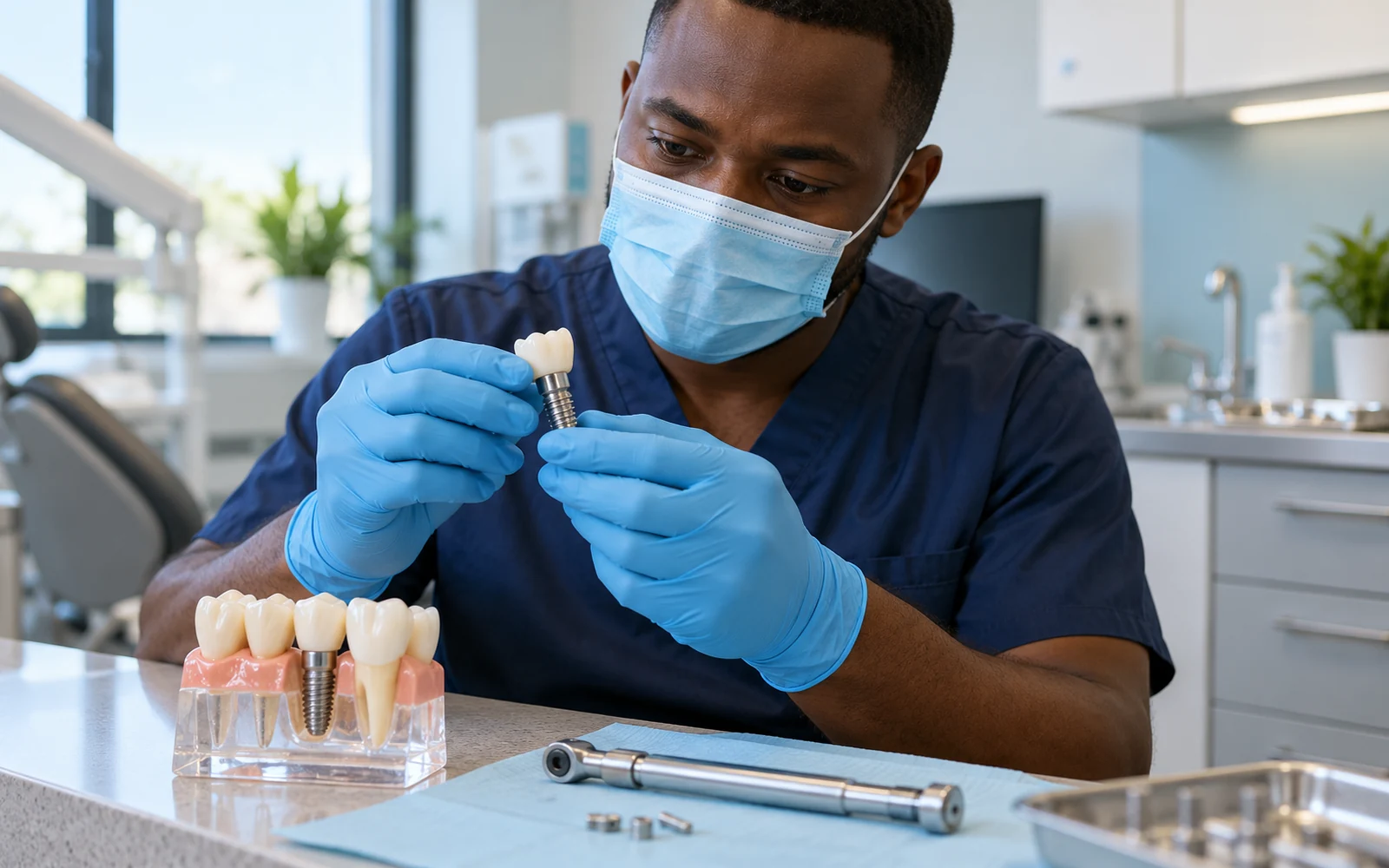
Where screw retention helps and what it asks of the case
Retrieval can be valuable when the clinician needs access to a prosthetic screw or must investigate a mechanical problem. The access route, however, needs to work with the implant position and the planned occlusal or esthetic surface. Check those relationships before approving the design.
Ask how the crown will be supported, which screw and driver are required, and whether any angulated access component is specifically approved. An attractive digital proposal does not demonstrate that the laboratory has used the correct library or component.
When planning implant crown retention, discuss access-hole restoration, contacts and the ability to inspect the prosthesis during maintenance. Keep a record of the assembly and the relevant manufacturer instructions so a future clinician can identify what has been placed.
Where cement retention needs particular attention
A cemented approach may help with certain access or esthetic constraints. The clinical plan must account for margin position, isolation, cement control and the ability to detect and remove excess. If the proposed margin will be difficult to inspect, discuss that concern with the laboratory before manufacture.
Do not assume a particular cement converts an inaccessible margin into a manageable one. Agree on abutment design and a procedure that the clinician can carry out predictably. Retrieval requirements should also be considered before selecting an approach that may complicate later access.

Compare implant crown retention for the actual case
| Planning question | What the answer changes |
|---|---|
| Where would screw access emerge? | Feasibility of the proposed design, appearance and functional surfaces. |
| Can a proposed cement margin be inspected? | Abutment design, excess-removal access and whether to reconsider the approach. |
| How will the crown be retrieved if needed? | The maintenance plan and the documentation to retain. |
| Can the patient clean the emergence contour? | Contour design, hygiene instruction and future monitoring. |
| Are the component and library identities complete? | Whether the case is ready for laboratory production. |
These questions often expose the real constraint. If the implant identity is uncertain, retention preference is not the first problem to solve. If the contour is inaccessible for cleaning, changing only the retention label may leave the maintenance problem untouched.
Send a complete implant crown prescription
In the implant crown retention prescription, include implant manufacturer, connection and platform identification; scan-body identity; the records obtained; the proposed retention approach; and any approved base or abutment requirements. Add opposing and bite records, shade information, soft-tissue context and relevant photographs.
Request confirmation of the component library and the planned emergence contour. Identify the person who will approve the design and how design changes will be communicated. For a remote laboratory relationship, a written clarification is more dependable than an unrecorded verbal assumption.

Implant crown retention: plan maintenance during design
The European Federation of Periodontology’s peri-implant disease guideline places prevention and supportive care throughout the implant pathway. Keep cleanability, baseline records and the review plan in the prosthetic discussion.
A clinic receiving a patient from another provider should obtain the restoration and component information whenever possible. Do not invent a universal tightening value. Use the relevant component manufacturer’s instructions and investigate a loose crown rather than automatically repeating a tightening procedure.
The digital implant workflow guide provides broader context for combining clinical records, laboratory design and prosthetic verification. Keep the specific retention decision documented alongside that workflow.
Ordering through the Denta24 laboratory service
Denta24’s new Zirconia Implant Crown service accepts case scans and tooth and shade selections, with laboratory communication through the customer account. Before submitting, ask the laboratory which implant systems and prosthetic configurations it can support for the individual case.
Confirm whether the proposed quotation includes the necessary base, screw or abutment, how design approval works and what records are needed for a remake assessment. The listing alone does not establish universal implant compatibility.
Keep the case information accessible after delivery
A useful handover includes a short assembly description, the component identities and the source of the relevant instructions. If the patient seeks care elsewhere, those details can prevent a clinician from guessing which driver or component is required. Review the Emotion laboratory service range when discussing the restoration order, and clarify the configuration for the actual case rather than assuming it from the catalogue.

Approve the implant crown retention prescription when the component identity, retention approach, tissue access and maintenance plan are clear. The most useful laboratory order is one that another clinician could later understand without guessing how the crown was assembled.
FAQs: implant crown retention
Is screw retention always the better choice?
No. Implant crown retention depends on position, access, components, appearance and maintenance requirements. The ITI consensus does not recommend one universal approach for every case.
What does implant crown retention mean?
It describes how the restoration is retained in the planned prosthetic assembly. Clarify the crown, abutment, base and screw relationships rather than relying on a product label.
Does a zirconia crown listing prove implant compatibility?
No. Confirm the exact connection, platform, scan body and approved components with the laboratory and the relevant manufacturer documentation.
What is the practical attraction of retrievability?
It can allow access for assessment and maintenance. The planned access route and the correct instruments still need to be available.
What is a major concern with intraoral cementation?
Control and removal of excess cement, particularly where margins are difficult to inspect. Address margin position and access during planning.
Is bonding a crown to a titanium base the same as cement retention?
Not necessarily. Extraoral bonding can be part of a screw-retained assembly. Describe the complete configuration in the prescription.
Can I use a standard torque value for every crown screw?
No. Use the instructions for the exact component and investigate the cause when a restoration becomes loose.
What should accompany an implant crown scan?
Implant and scan-body identification, relevant soft-tissue records, opposing and bite records, shade information, photographs and the proposed prosthetic configuration.
Should emergence contour be reviewed before manufacture?
Yes. Discuss tissue relationships and the patient’s ability to clean the area while the design can still be changed.
What should be kept in the final case record?
The implant connection and components, restoration configuration, relevant instructions, delivery findings and the agreed review and maintenance plan.
This guide supports prosthetic planning. System-specific component instructions and the clinician’s assessment determine the final restoration.
Images are AI-generated editorial illustrations, not patient records or photographs of specific branded products.


