 Endodontic Rotary Files
 Finishing Burs
 High-Speed Burs
 Low-Speed Drills
 Cosmetic Accessories
 Home Whitening Kits
 Clinic Whitening Kits
 Implant Accessories
 Implant Fixtures
 Prosthetic Components
 Surgical Implant Tools
 CAD & CAM Materials
 Lab Consumables
 Lab Equipment
 Digital Dentistry Devices
 Endodontic Equipment
 General Clinic Equipment
 Restorative Equipment
 Surgical Equipment
 Hand Files
 Irrigation & Medicaments
 Post & Core
 Rotary Files
 Sealers
 Brackets & Wires
 Clear Aligners
 Orthodontic Accessories
 Bonding & Adhesive Systems
 Finishing & Polishing
 Matrix Systems
 Etching Materials
 Composite Materials
 Occlusion Checking
 Bone & Grafting Materials
 Surgical Accessories
 Surgical Consumables
 Cementation
 Impression & Registration Materials
 Temporary Restorations
 Periodontal Instruments & Accessories
 Periodontal Treatment Materials


Orthodontic Bite Turbos: Indications, Placement, Monitoring and Safe Removal


Orthodontic Bite Turbos should be evaluated through clinical evidence, workflow fit and local operating conditions. A sound orthodontic bite turbos decision connects verified performance with the team, patients and resources that will support it in daily practice.
Bite turbos are small bonded buildups used to separate the arches, protect brackets or help manage selected occlusal relationships. Their size makes them appear simple, but incorrect placement can create unstable contacts, excessive forces or unnecessary discomfort.
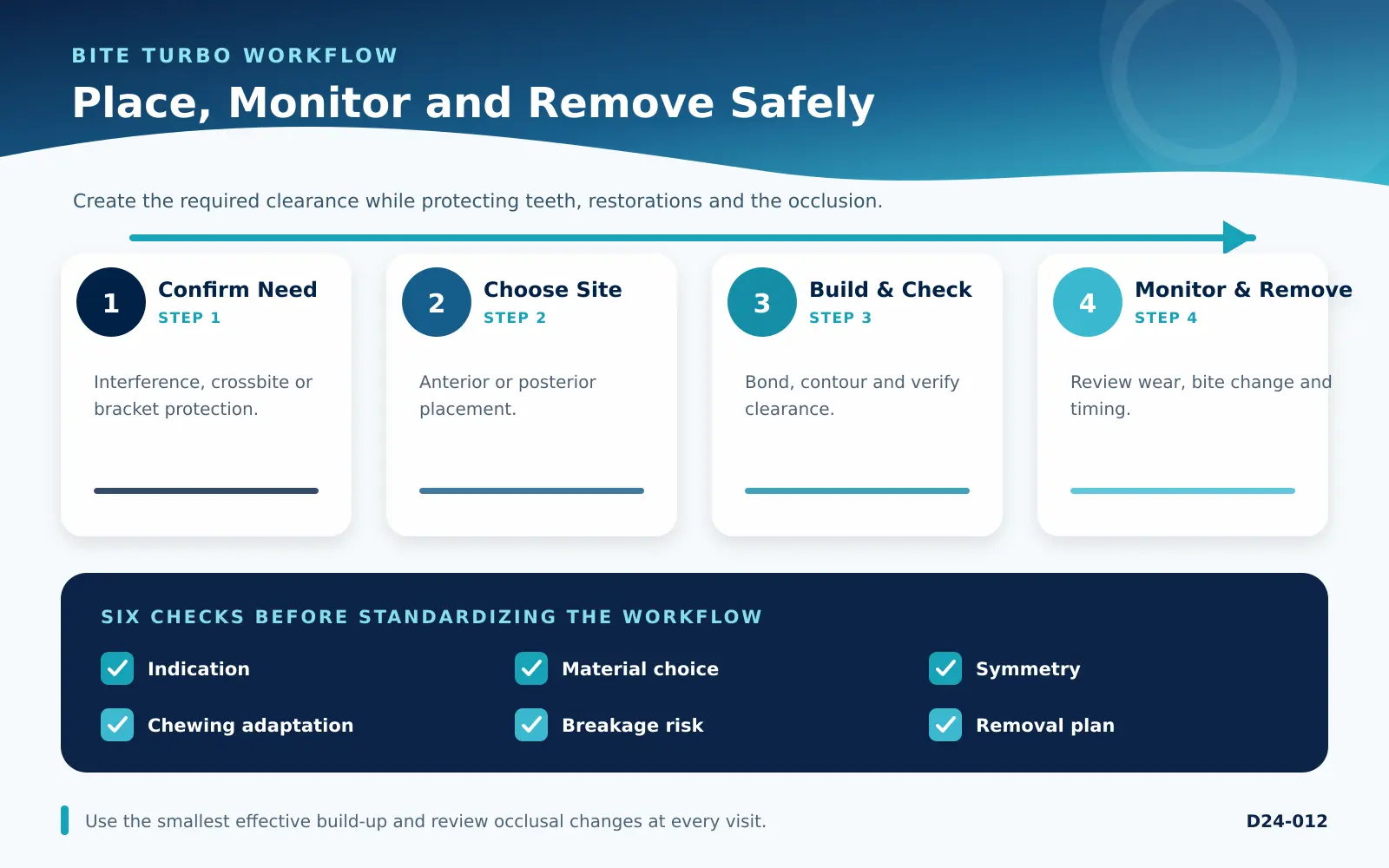
Quick answer: Orthodontic bite turbos should be placed only as part of a defined biomechanical plan. The clinician must choose anterior or posterior placement, control height and symmetry, monitor wear and remove the material without damaging enamel.
Table of Contents
What Do Bite Turbos Do?
Bite turbos create temporary disclusion. Depending on placement, they may:
- Prevent lower incisors from contacting upper brackets.
- Open the bite to assist crossbite correction.
- Support deep-bite treatment.
- Reduce selected occlusal interferences.
- Protect bonded appliances during early treatment.
Anterior vs Posterior Placement
Anterior bite turbos may be bonded to the palatal surfaces of upper incisors or another planned location. They can separate posterior teeth in selected deep-bite mechanics.
Posterior bite turbos are often placed on molars or premolars to separate anterior teeth or free a crossbite.
The choice depends on diagnosis, occlusion, periodontal support and the intended tooth movement.
Clinical Indications
- Deep overbite with bracket interference.
- Anterior or posterior crossbite mechanics.
- Protection of newly bonded brackets.
- Temporary disclusion during specific treatment stages.
Bite turbos are not a complete treatment for every deep bite. They must be coordinated with archwires, elastics, attachments or other mechanics.
Planning the Height
The turbo should create enough clearance for the treatment objective without producing excessive opening or unstable loading. Check:
- Simultaneous planned contacts.
- Mandibular displacement.
- Patient comfort.
- Clearance of brackets and crossbite.
- Functional movements.
Asymmetric or excessively high buildups may produce unwanted shifts and discomfort.
Bonding Protocol
Clean the tooth, isolate the field and follow the material’s etching, bonding and curing instructions. If the product is self-adhesive or has a specific protocol, do not add unvalidated steps.
Use enough material to achieve durable contact, but avoid unnecessary bulk.
Why a Colored Material Can Help
A blue or otherwise visible composite is easier to identify during placement, review and removal. This can reduce the chance that material remains unnoticed on enamel.
Patient Adaptation
Patients may initially experience:
- Changed chewing.
- Speech alteration.
- Muscle fatigue.
- Awareness of uneven contacts.
Explain that adaptation is expected, but severe pain, a fractured turbo or inability to function requires review.
Monitoring
At orthodontic appointments, inspect:
- Wear and fracture.
- Debonding.
- Occlusal changes.
- Enamel and gingival condition.
- Whether the original objective still exists.
Do not leave turbos in place longer than necessary simply because they remain bonded.
Safe Removal
Use visible color, magnification where available and controlled finishing instruments. Work slowly, preserve enamel and polish the surface after removal. Confirm that the bite is stable and that no sharp material remains.
FGM Ortho Bite Blue
FGM Ortho Bite Blue is listed by Denta24 as an orthodontic composite for bite buildup. Verify the current bonding protocol, curing time, working characteristics and removal recommendations.
African Clinic Considerations
When patients travel far for appointments, provide written instructions for fracture or discomfort and arrange a practical communication channel. Select a material whose storage, delivery and replacement are reliable in the clinic’s market.
Orthodontic Bite Turbos: Practical Checks for African Clinics
For African clinics, orthodontic bite turbos is not a product-only decision. It must also account for material availability, bonding protocol, curing-light output, follow-up access, dietary advice, occlusal monitoring and safe removal instruments. A resilient orthodontic bite turbos plan should remain workable when supply, connectivity, service access or patient follow-up is less predictable than expected.

Before adoption, document who is responsible, which current instructions for use apply, how outcomes will be measured and what will trigger referral, retraining or a change in protocol. The goal of orthodontic bite turbos is to use the smallest effective build-up, verify balanced contacts and give the patient a clear review plan for discomfort, fracture or premature loss.
- Verify material availability before implementation or purchase.
- Verify bonding protocol before implementation or purchase.
- Verify curing-light output before implementation or purchase.
- Verify follow-up access before implementation or purchase.
- Verify dietary advice before implementation or purchase.
- Verify occlusal monitoring and safe removal instruments before implementation or purchase.
Use orthodontic bite turbos as an operational decision that is reviewed after real cases. Record complications, remakes, chair time, consumable use, stock-outs and team feedback, then refine the protocol from evidence rather than marketing claims.
Related Denta24 reading: selecting reliable dental materials. This context helps place orthodontic bite turbos within a broader clinical and digital strategy.

Conclusion
Orthodontic Bite Turbos succeeds when the evidence, local workflow and review plan remain aligned. Bite turbos are effective when they are planned, measured and monitored. Their success depends on biomechanics and occlusal control, not only on the composite used.
Frequently Asked Questions
What is an orthodontic bite turbo?
For context, orthodontic bite turbos should always be adapted to the individual case and the current evidence. It is a bonded occlusal buildup used to disclude teeth, protect brackets or support selected bite correction.
When are anterior bite turbos used?
They may be used in selected deep-bite situations to separate posterior teeth and protect lower brackets.
When are posterior bite turbos used?
They may disclude anterior teeth or help manage crossbite and bracket interference.
Can bite turbos cause discomfort?
Temporary chewing and speech adaptation is common, but severe or persistent symptoms require review.
How is the correct height determined?
It should achieve the planned clearance without excessive opening, displacement or unstable loading.
Why use a blue composite?
Visibility can help placement, monitoring and enamel-safe removal.
What bonding steps are required?
Follow the material’s current cleaning, isolation, etching, bonding and curing instructions.
How often should turbos be checked?
Inspect at orthodontic visits and sooner if they fracture, detach or cause significant symptoms.
How are they removed safely?
Use controlled finishing, good visibility and polishing while preserving enamel.
Can every deep bite be treated with turbos?
No. They are one tool within a complete orthodontic diagnosis and force system.
References and Further Reading
Professional disclaimer: Bite turbos must be prescribed within an orthodontic treatment plan and applied by a trained clinician.


